While “boutique hotel” has become a washed-out concept, gutted of its substance by marketing, a convenient label slapped onto any halfway decent establishment to justify a price tag, Anhill refuses to play that game.
It restores order.
Here, nothing exists just to “look pretty.” Every line, every material, every void is a calculated decision. One does not decorate: one composes.
One does not follow a trend: one imposes a vision.
In Hue, the slightest stylistic misstep is paid for in cash.
Too much past, and you fall into dusty reenactment. Too much contemporary, and you become rootless. Most fail somewhere in between. Anhill walks this ridgeline with an almost insolent tightrope precision. It takes this heavy, intimidating heritage and, instead of bypassing it, it grips it tight. In this kind of exercise, there are only two outcomes: pastiche or the right gesture.
Here, it is the right gesture.
A family history that bleeds through
Anhill is no only-child’s whim.
It is a family affair, yes, but without the softness that usually follows. The son, Tiến, didn’t pass through some international-stamped design school, calibrated to produce globalized taste. He studied in Ho Chi Minh City.
And better yet: he left.
He traveled, not to check off boxes, but to rub shoulders with the world, to get a bit of grit in his gaze. The result: no clean copy-pasting. No folklore kept under glass. What he offers is something else.
Something rawer, almost organic.
Then there is the father.
Rooted in his family land. Over a hectare to hold, to turn over, to understand. Not to make it beautiful, but to make it live. The uncles are never far. They don’t decorate the place; they inhabit it. They are its memory, its gestures, its rites.
Here, culture isn’t a window display. It’s a family matter.
A hotel in dialogue with its neighbors
You only need to wander the surroundings, by bicycle, so as not to rush anything, to realize that Anhill, beneath its disciplined air, is quite the talker.
A place that speaks, especially to its neighbors.
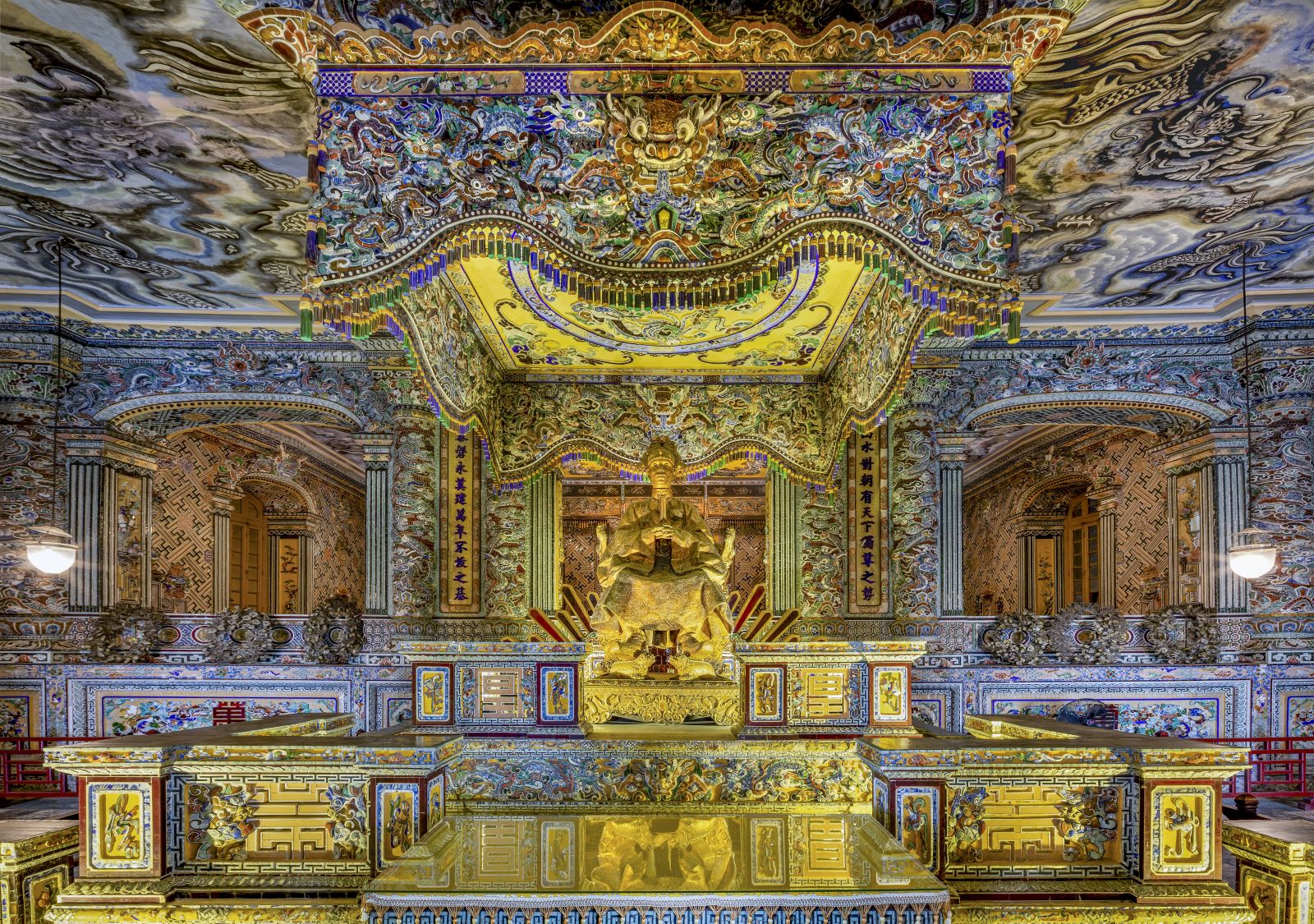
Starting with the most disconcerting of them: Khai Dinh.
A baroque Emperor, long misunderstood, who dynamited the codes of imperial architecture. He would have found in Anhill a fascinating echo of his own audacity. A spiritual kinship jumps out at me between the Emperor and Anhill’s designer. Both are masters of the hybrid. We often forget that Khai Dinh was the first to impose reinforced concrete in Hue for his own tomb. At the time, it was absolute sacrilege against the tradition of wood and brick.
Anhill’s board-marked concrete ceilings extend, in their own way, this original rupture.
But where Khai Dinh used crushed glass and shattered porcelain to fill every inch of void, Anhill uses the void as a material.
Where one stacks, the other strips. One gets drunk; the other decants.
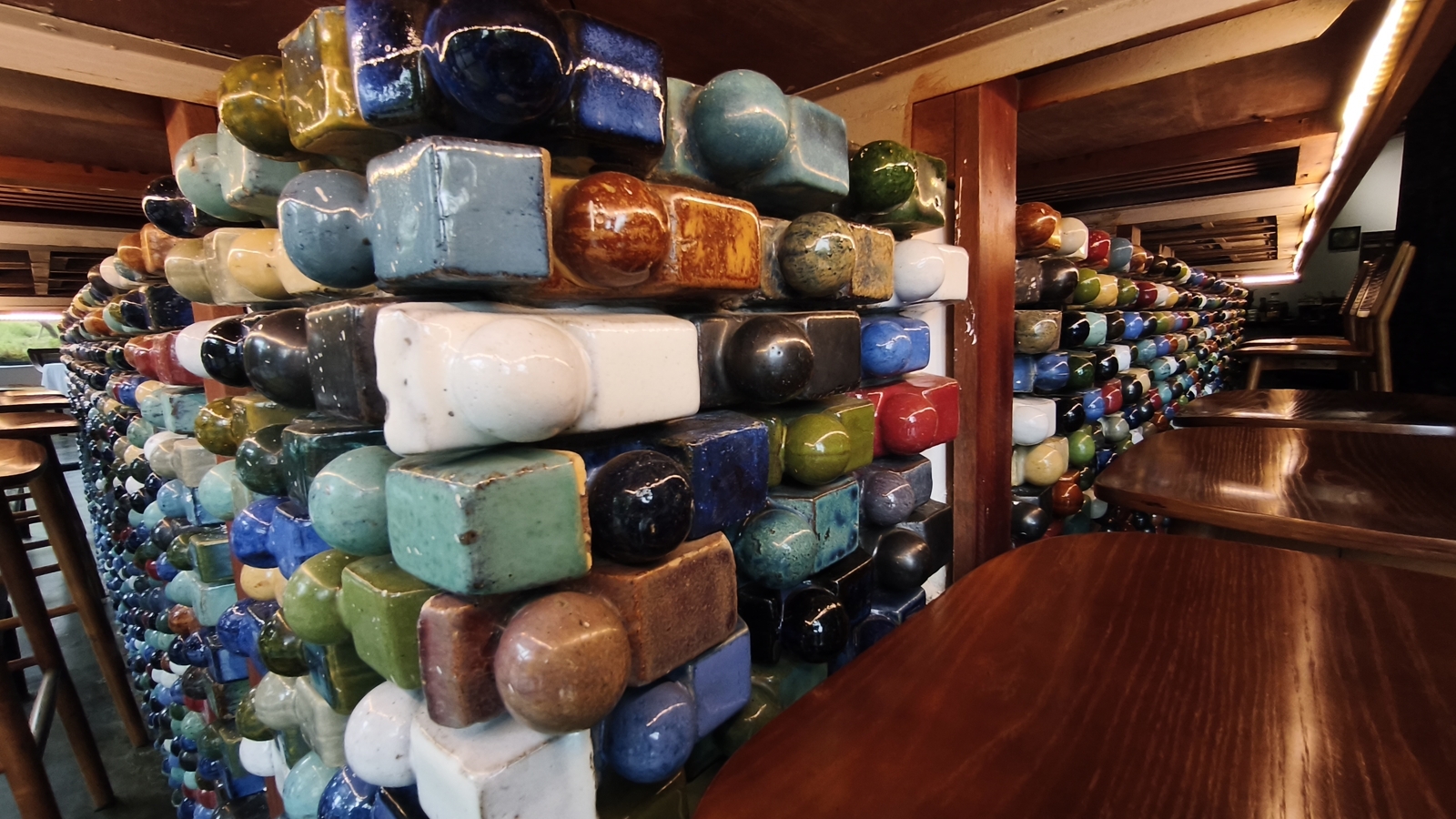
With one exception: the bar.
Just as Khai Dinh repeated dragon and flower motifs in broken porcelain to infinity, the bar multiplies identical ceramic modules. The eye is overwhelmed by the density of the stack. It is the end of “less is more” minimalism in favor of a baroque, kitsch “more is not enough.”
We are in the same visual intoxication as in the Thien Dinh Palace.
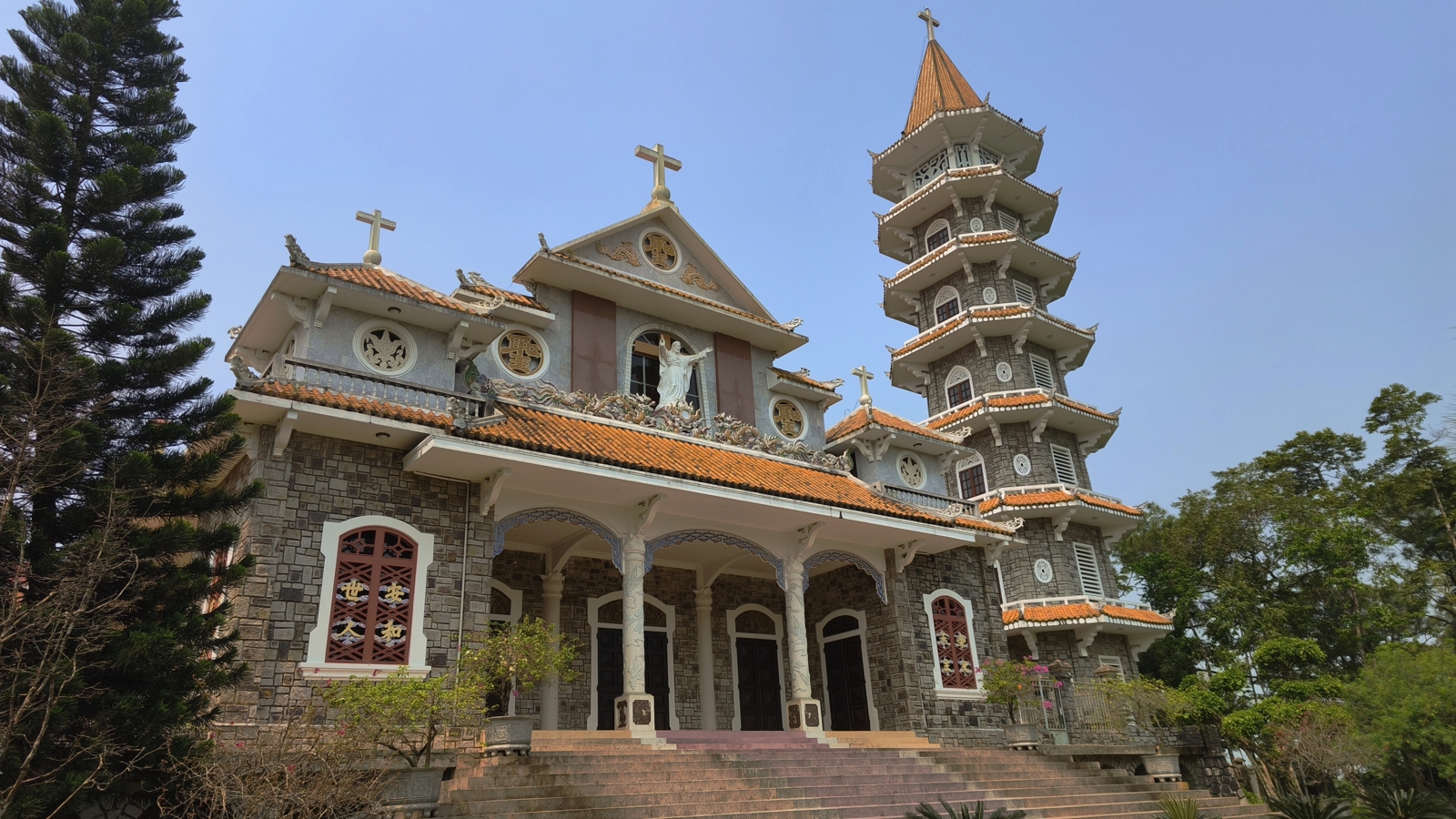
If Khai Dinh is the neighbor of audacity, the Thien An monastery is the neighbor of temperance.
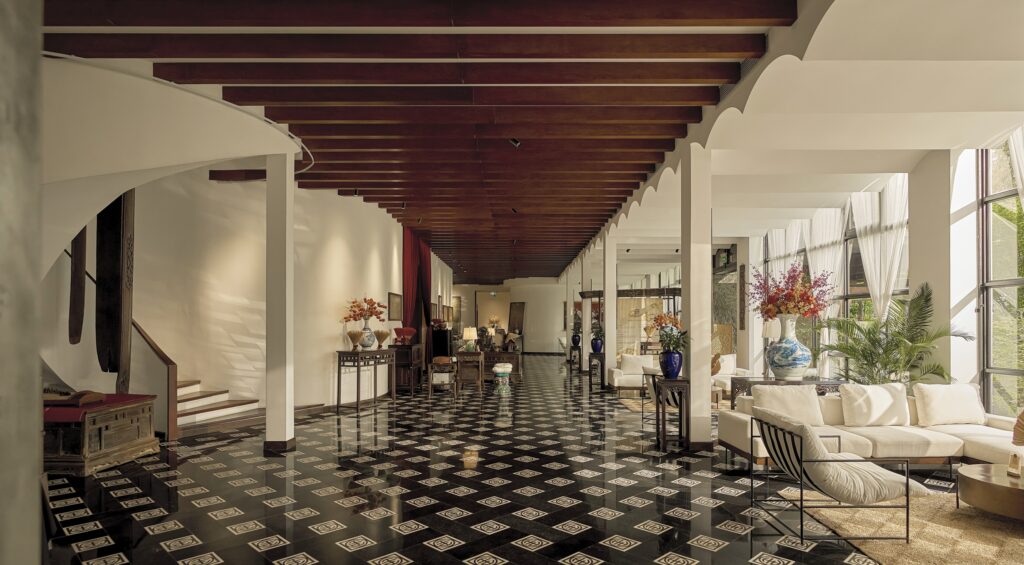
Anhill’s corridors borrow the monastery’s cloistral rhythm. See how the repetition of openings creates a visual metronome. The successive passage from light to shadow naturally imposes a slowdown. The rooms are not just minimalist: they flirt clearly with the monastic. Not in flat mimicry, but in an attitude of divestment.
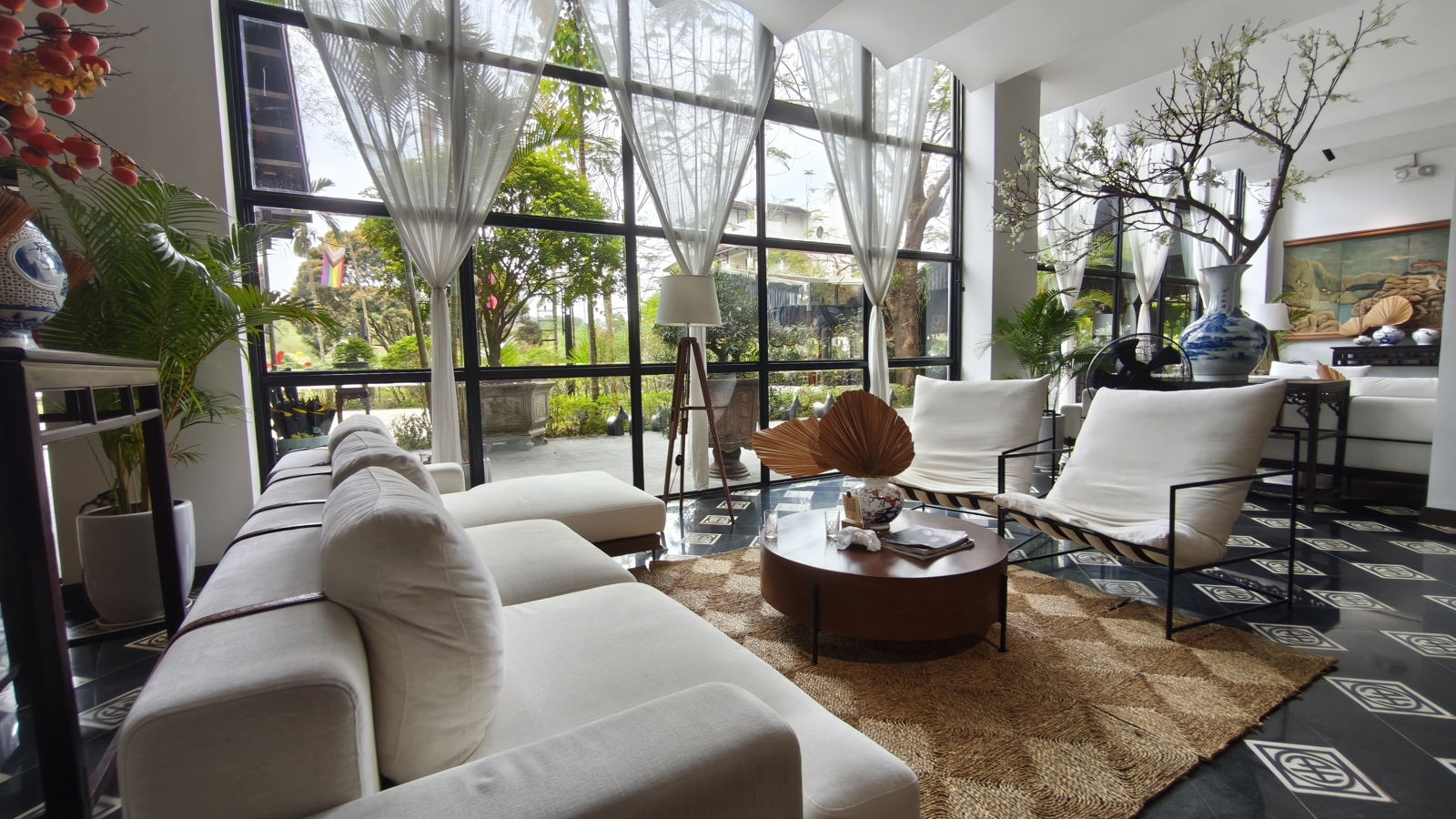
As for the lobby’s white drapes, through their transparency and lightness, they are not unlike the delicacy of a bridal veil.
And then, there is the neighbor slightly further afield, the discreet one.
The Katu people bring a sober elegance to the villas.
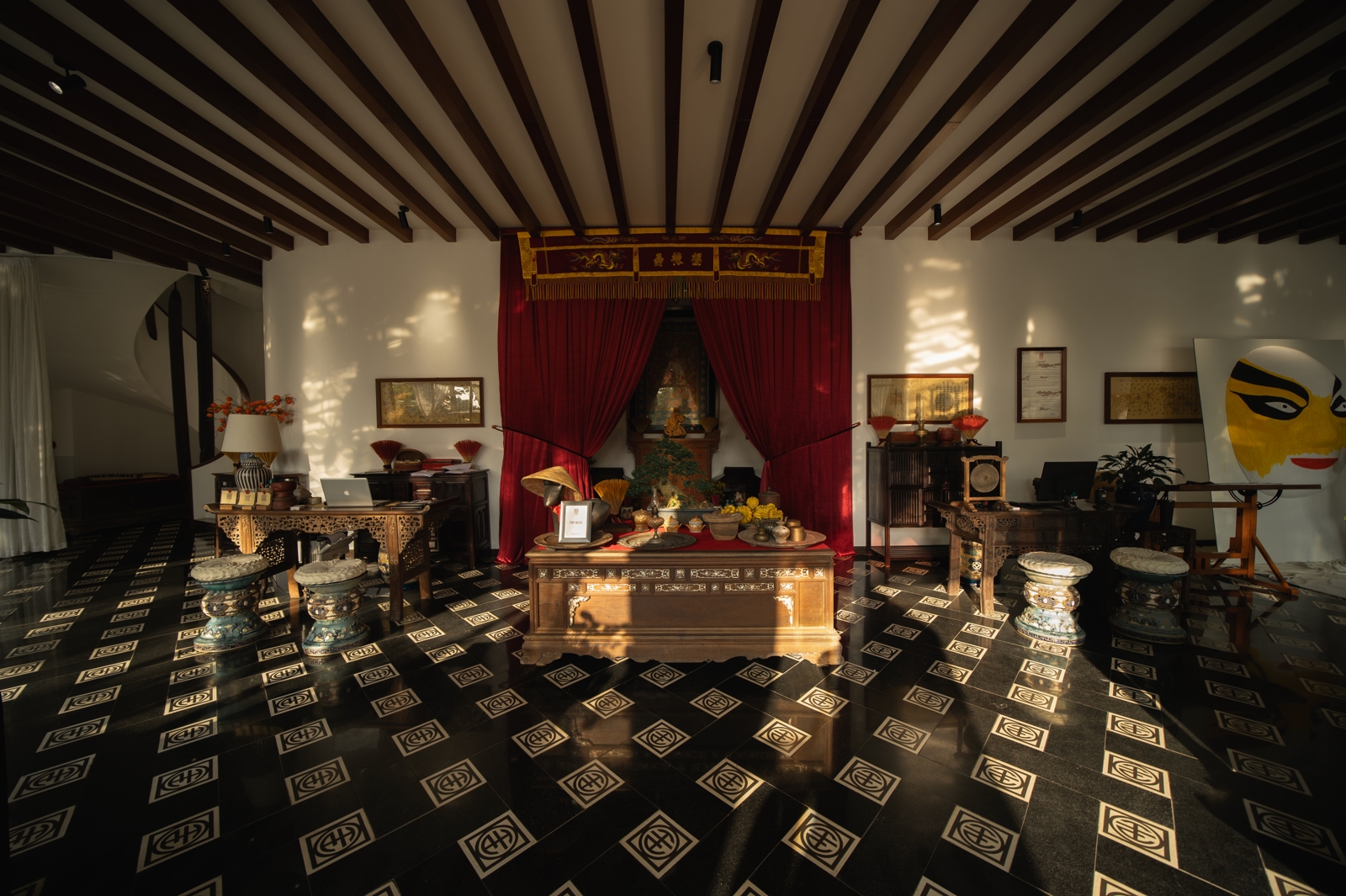
Geometric patterns on chair throws, totem pillars, a legible constructive logic close to communal houses, and the deep, saturated red of the rugs symbolizing vitality, celebration, and sacrifice. References, yes, but without heavy folklorization.
The villas don’t copy the Katu.
They negotiate with them.
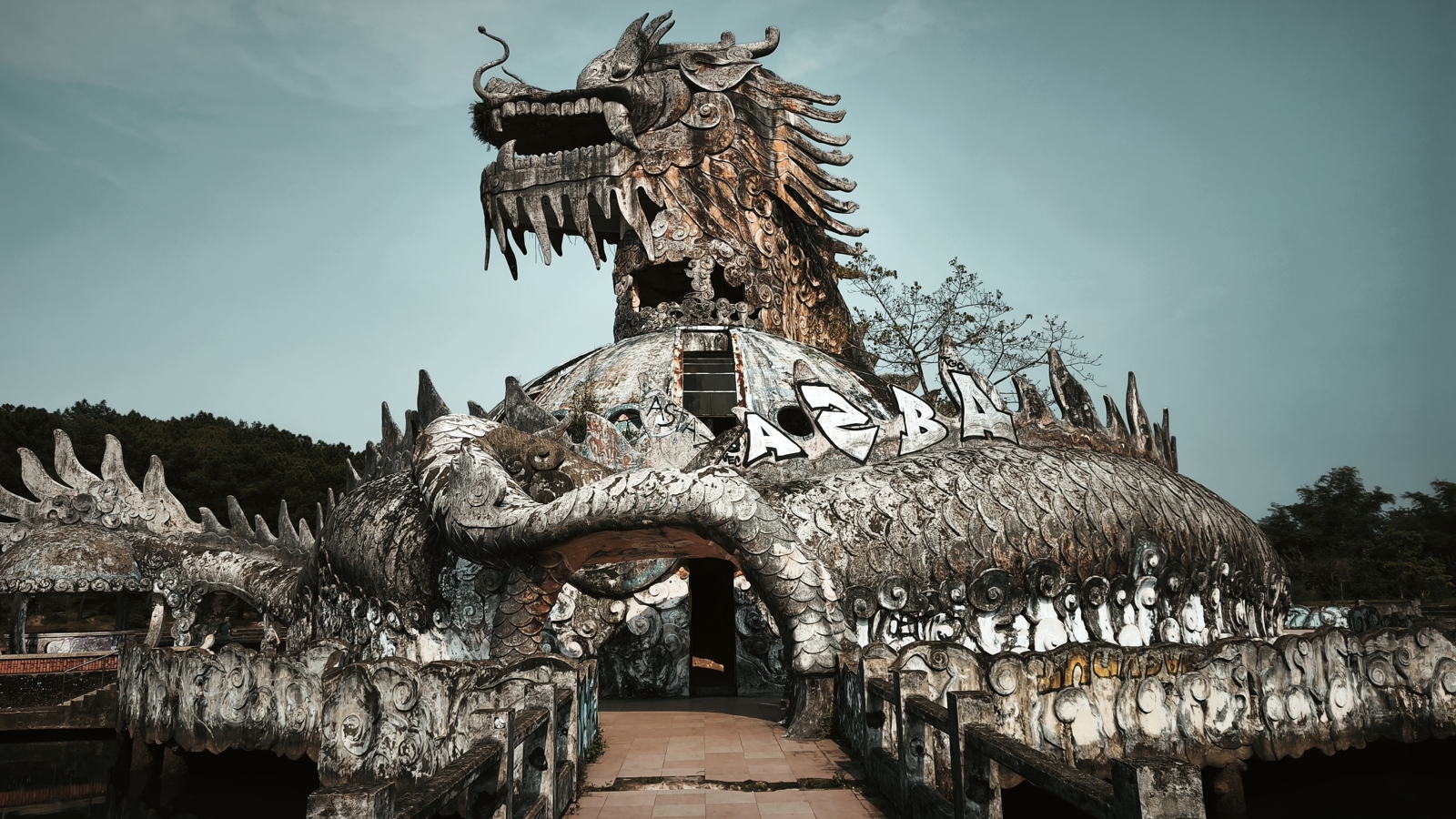
And what if, in the end, it was that “trashy” neighbor who spat all these ideas at our artist?
I mean that punk dragon sitting apocalyptically at the end of Thuy Tien Lake. Perhaps it was in that carcass of raw concrete and scrap metal that Anhill found its purest audacity.
But with good manners. The manners of Hue.
The artist’s exact intention escapes me. My interpretation, however, does not hold back. Baroque in its own right.
That is precisely where the strength of this place lies: it doesn’t just let you pass through. It demands you stop.
Creative mixology
The kind that doesn’t dilute flavors, but exacerbates them.
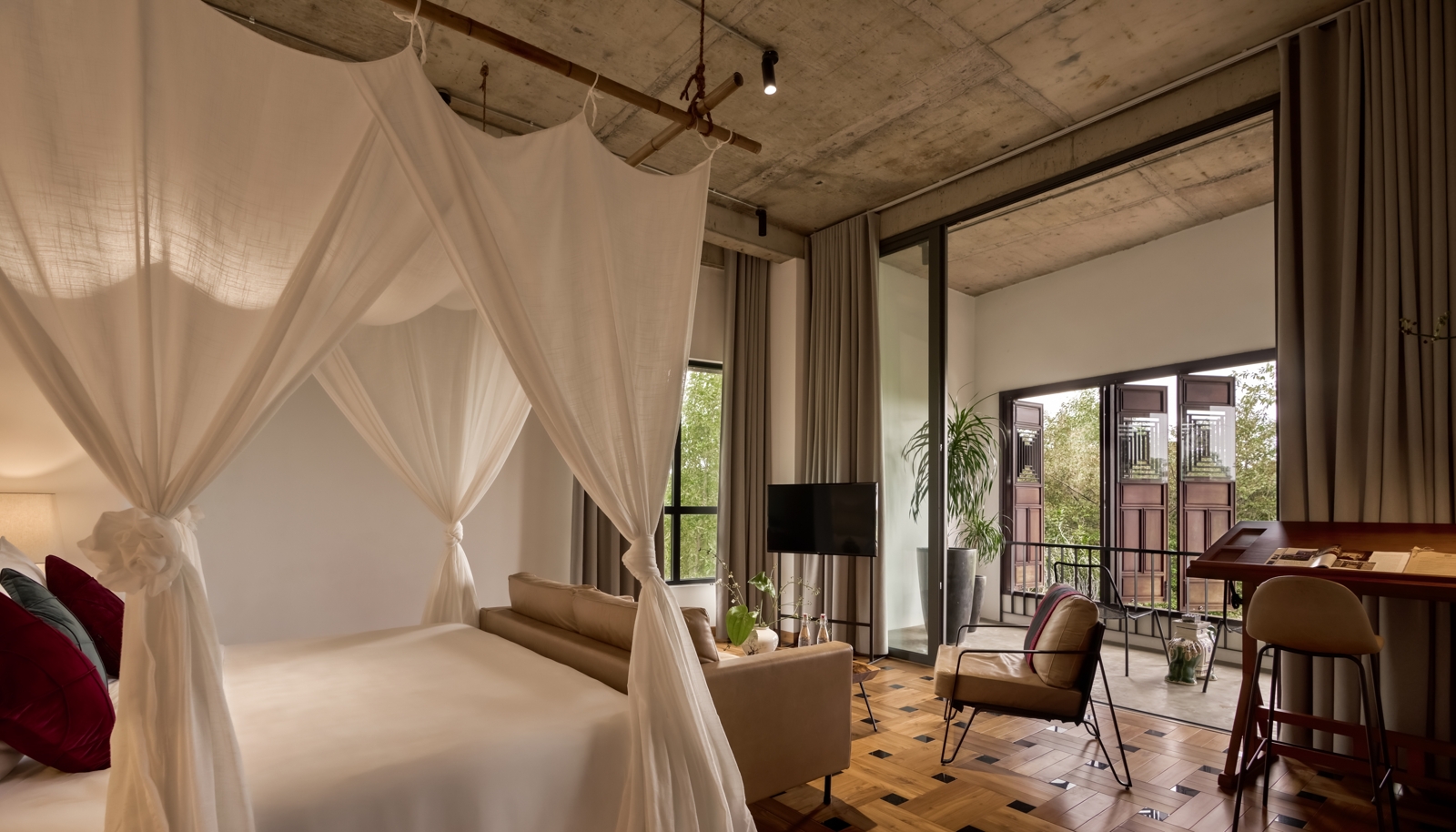
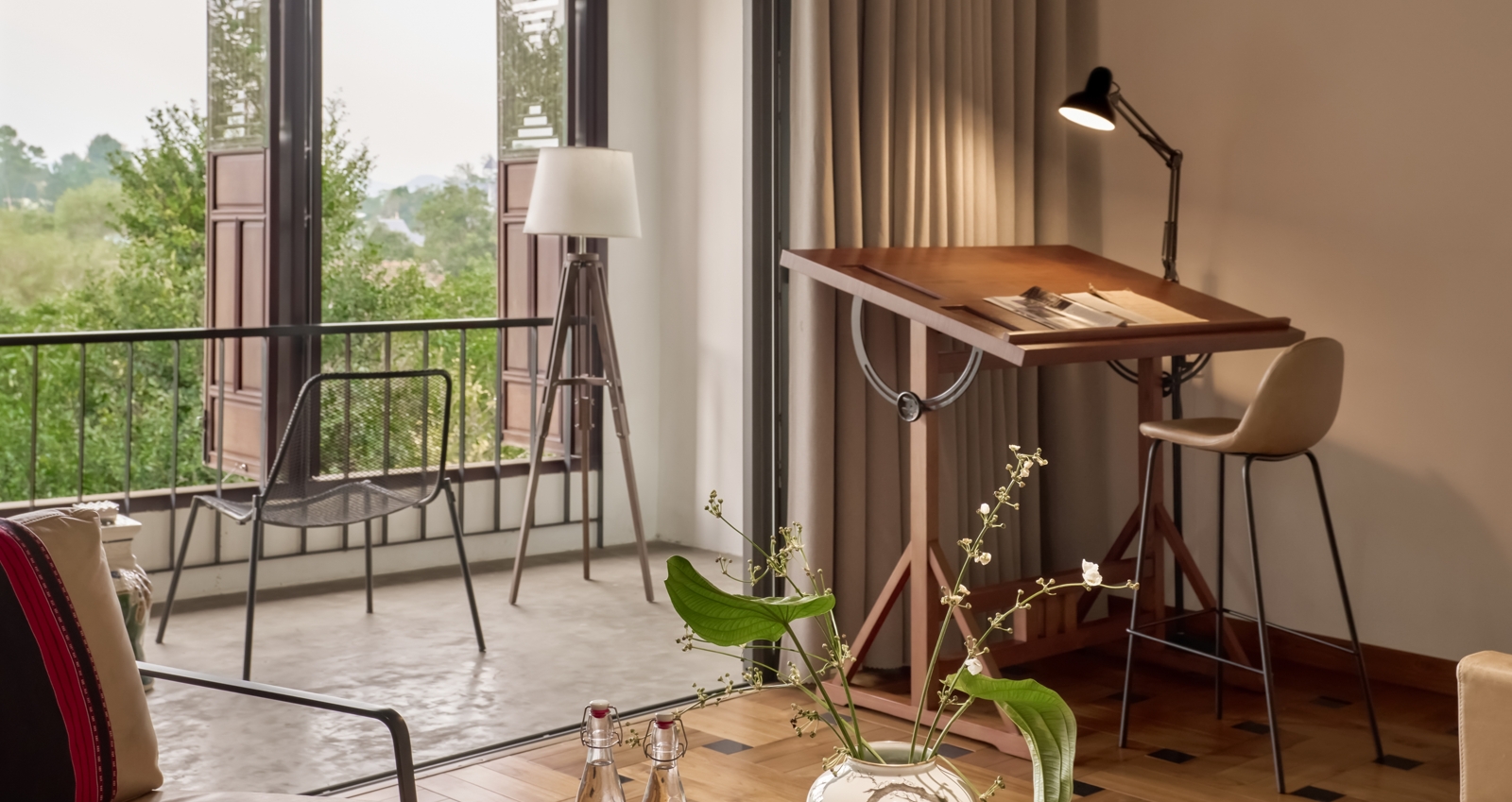
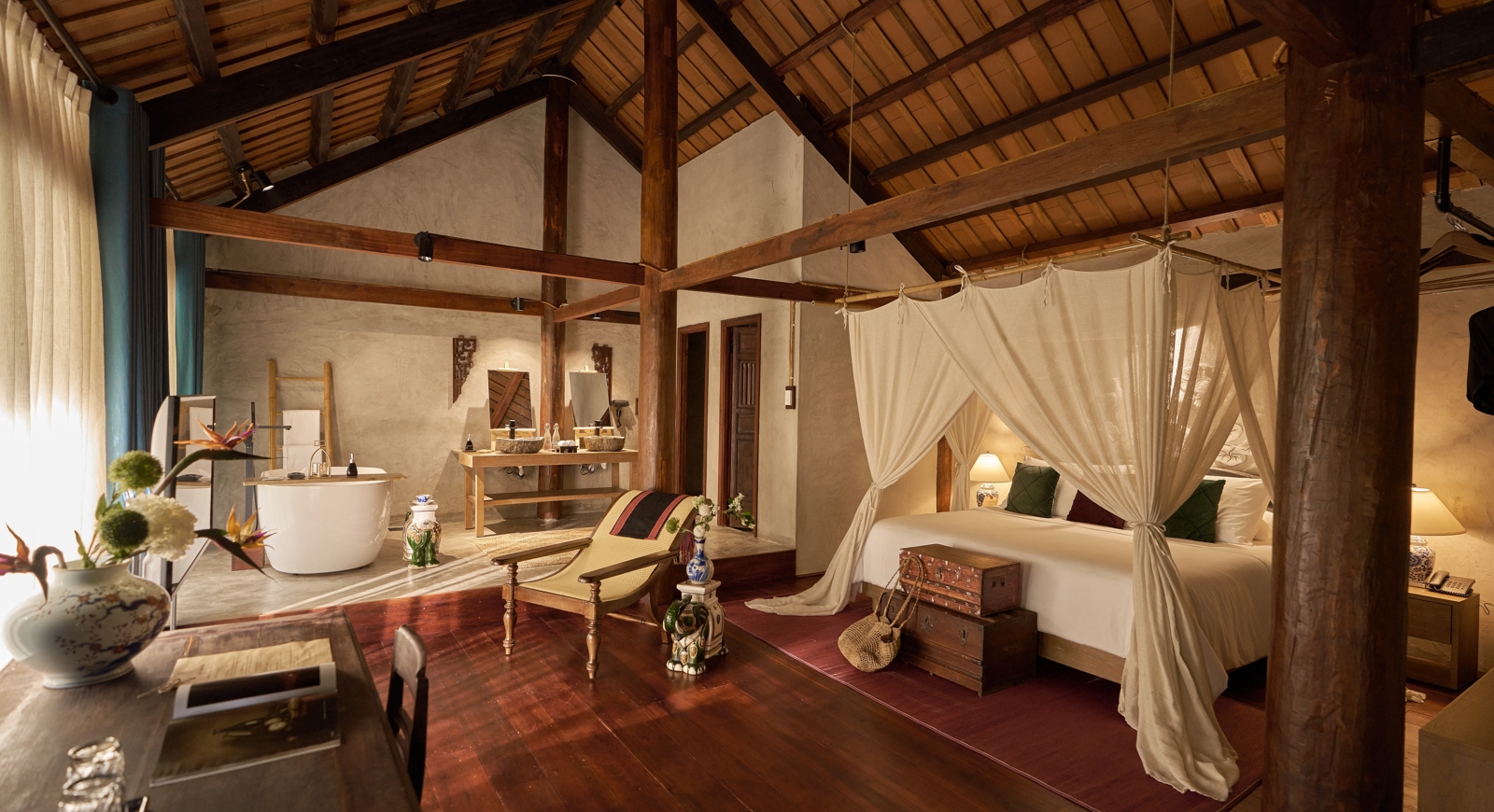
We are far from the lukewarm, consensual cocktail of classic luxury hotels. Here, the blend is tight, dry, almost brutal. Stepping into a suite is to enter a kinship of spirit with Le Corbusier, especially with that exposed raw concrete ceiling underlining a logic of “truth in materials.” Though the glass is vertical here, the spirit of the façade libre is present, letting light in as the primary material. The structure is legible; nothing is hidden, everything is owned. The mix of metal structures and organic materials fits this modernist will. And then, that drafting table, the final stylistic blow.
A true aesthetic manifesto.
Another detail: the bathtub isn’t there for show or to serve as a backdrop for a vaporous selfie. It answers the drafting table with its unadorned functionality.
It is deeply Corbusian in intent, with an almost New York vibe in its open volumes, exposed metal, and loft spirit.
And then, everything shifts. This rigor is softened, pierced by a tropical and heritage-driven imagination that warms the line without ever making it soft. Finally! We exit the boring colonial caricature to enter something far more hard-hitting, more incisive.
We are no longer in reverence.
We are in the gesture. Pure. Radical.