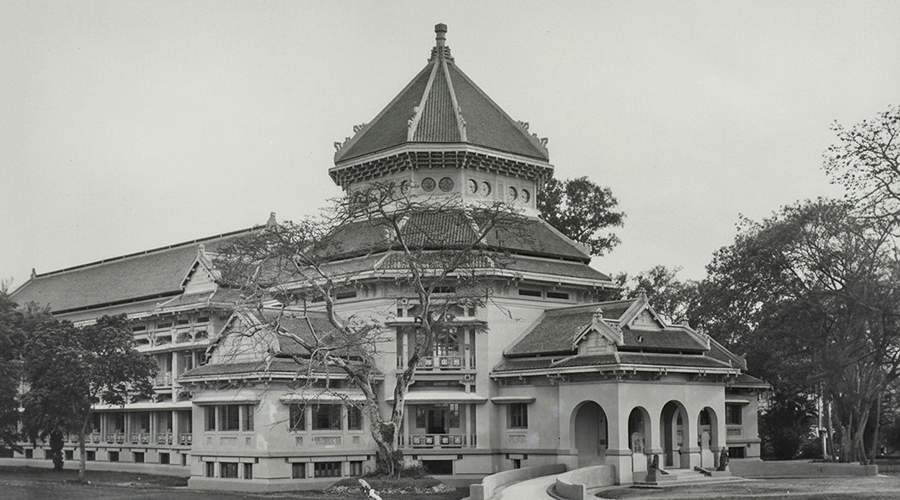
While French neoclassical architecture certainly bestowed upon Hanoi that photogenic “French Quarter” south of Hoan Kiem Lake, a far more martial intent lurked behind those cheerful facades.
These palaces, these colonnades, and this overt monumentality were anything but innocent: it was France, clad in a costume of stone, proclaiming the gravity of its colonial project and the supposed superiority of its civilization.
What we call “colonial charm” today was, back then, a strategy of intimidation, an aesthetic of power that did not wish to converse with Hanoi, but to redraw the city in its own image. In short, these were uniforms of stonework for a State that dreamed less of integration than of submission and total transformation.

Historical context and objectives
When the French landed in Hanoi at the end of the 19th century, they didn’t arrive in their starched uniforms just to blend into the woodwork.
They came with a dream cast in concrete, in stone, in colonnades.
Thus, prestige had to be planted on every street corner. A bit of panache here, a great deal of presence there, anything to lend luster to that noble “civilizing mission” brandished like a proud banner. Facades were built to proclaim that they would stay for a long, long time, and that they fully intended to live in the tropics with the same bourgeois conveniences found on the grand boulevards.
Fortunes were made here, certainly, but comfort had to remain Parisian.
After all, the Portuguese were flaunting an opera house in the middle of the Brazilian jungle; there was no reason the Tonkin should be deprived of its own whim. One might have to parley with a few local amoebae, provided one could suffer from intestinal woes amidst gilding, moldings, and everything that glitters. For yes, we Europeans do not just have large noses; we have, above all, large projects. And so, the city was redrawn with columns ablaze with pride, pediments that took themselves quite seriously, and that veneer of the Enlightenment that permitted every audacity.
And as long as they were playing the role of inspired civilizers, they broke out the neoclassical gear : the grandeur of Greco-Roman Antiquity as a moral guarantee to dress public buildings in impeccable authority.
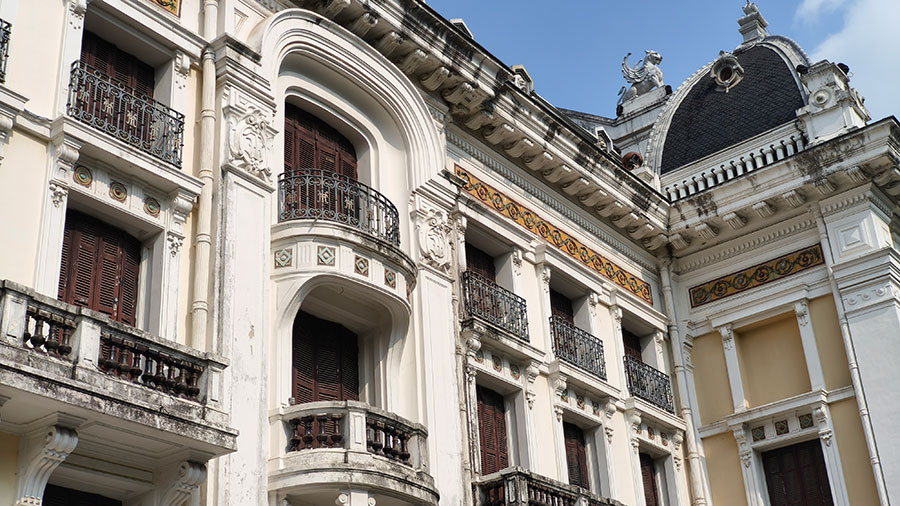
Neoclassicism : the costume of power
For living, entertaining, or a bit of parading, we treated ourselves to a hodgepodge of Biarritz-style villas, Norman cottages, Art Deco whims, or Belle Époque excesses.
But for governing, educating, healing, imposing, taxing and, if necessary, punishing, the fantasies were tucked away : there, one needed the heavy artillery, the strict architecture, the Neoclassical style as upright as a verdict.
Neoclassicism is about elegance, but above all, it is about a profound disdain for the local context.
Unlike the “Indochinese style” that would appear later, Neoclassicism completely ignores its surroundings. It is an imported architecture; there is no effort to adapt to the tropical climate, no wide ventilated verandas or overhanging roofs, for instance. Culturally, Neoclassicism was erected by razed a portion of Hanoi’s historical heritage to impose a European aesthetic, as if the ground were a tabula rasa.
Neoclassicism in Hanoi is not an architecture of dialogue; it is an architecture of monologue. It is the sovereign gait and that slight Parisian disdain for anything that is not itself.
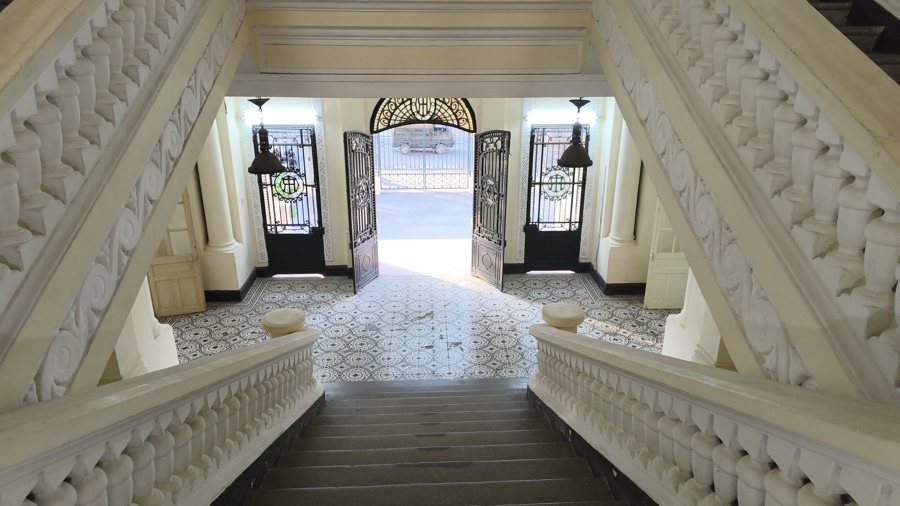
Auguste Henri Vildieu : the builder of institutions
One could say that Auguste Henri Vildieu literally redrew a whole section of Hanoi on his own.
As the chief architect of Indochina at the end of the 19th century, he peppered the city with a series of buildings where French Classicism already mingled with the first attempts at tropical adaptation. His work carries that solid touch, very Third Republic, but with an almost scenographic sensibility.
Vildieu remains the one who laid the foundations of institutional colonial Hanoi and the author of the buildings that, even today, serve as the nerve centers of the Vietnamese state.
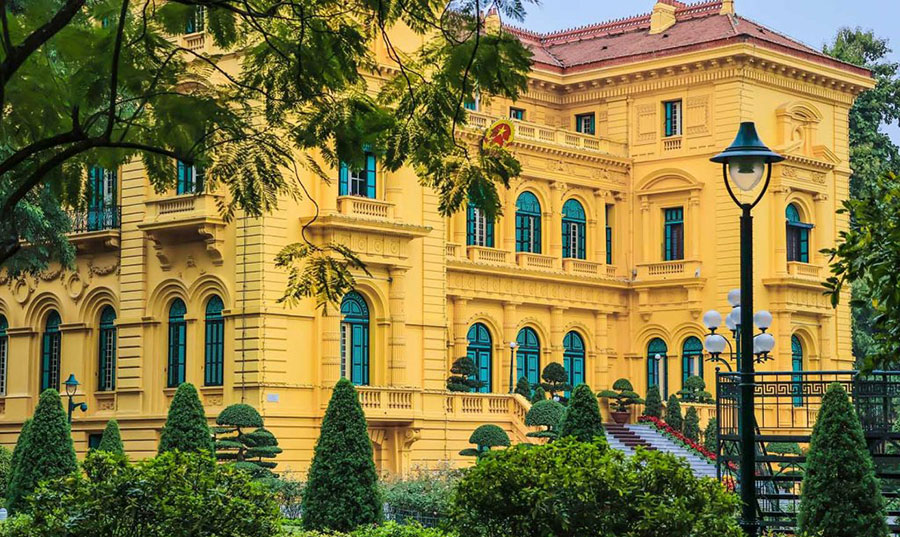
The Presidential Palace : This is the apotheosis of Beaux-Arts in Hanoi, a manifesto in stucco and self-importance, built so the Governor-General could lounge there, imagining himself halfway between Versailles and Saigon. After 1954, Ho Chi Minh preferred the frugality of a stilt house at the back of the park, a way of reminding us that power does not always need marble to be heard.
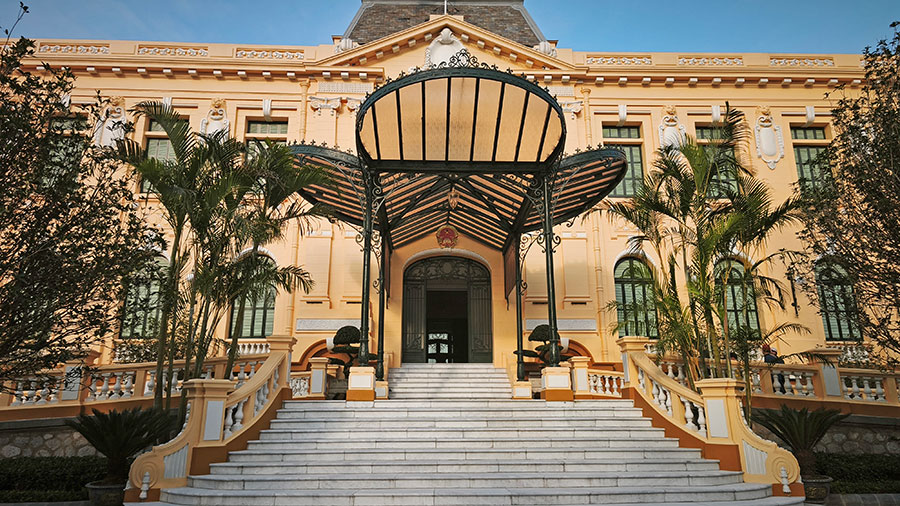
The Tonkin Palace : Nestled near Hoan Kiem Lake, this former stronghold of the Resident Superior advances its impeccable classicism with quiet arrogance. Its wrought-iron canopy floats like a socialite’s veil above a very Third Republic portico. One of the city’s neoclassical jewels, if you happen to like buildings that show up in a three-piece suit in a country of light shirts.
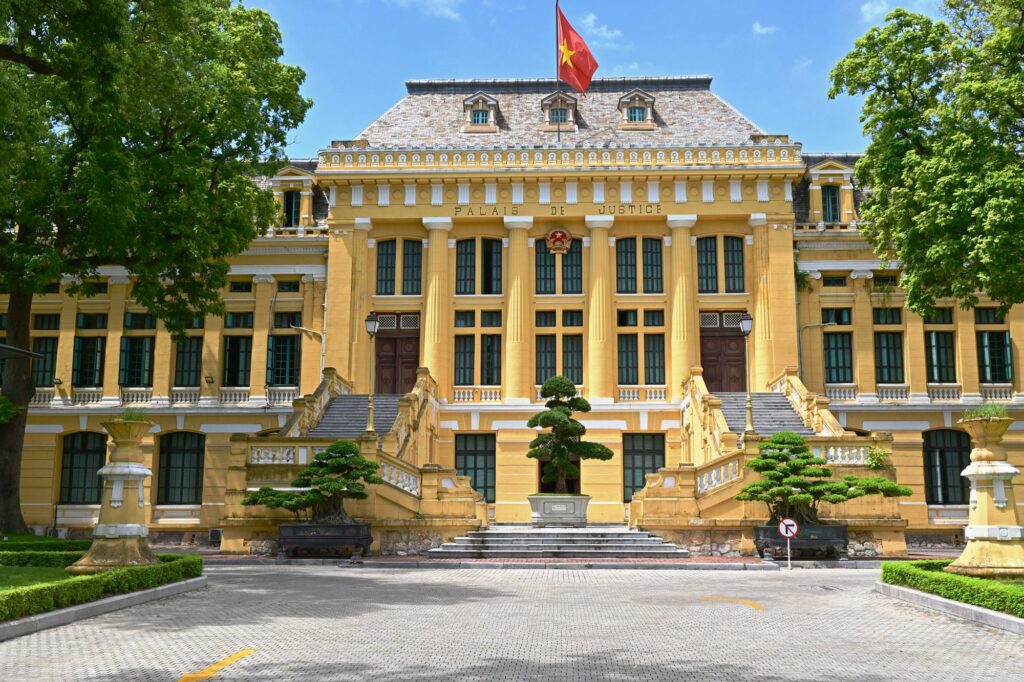
The Hanoi Courthouse : A solemn block set on a stone base, two projecting wings like shoulders asserting themselves, and at the center, a colonnade that declaims the law with the confidence of a Parisian prosecutor. Fluted pilasters, a martial cornice, impeccable symmetries: everything here tells of the absolute certainty of embodying order, the Republic, and good taste.
François-Charles Lagisquet : the elegance of the spectacle
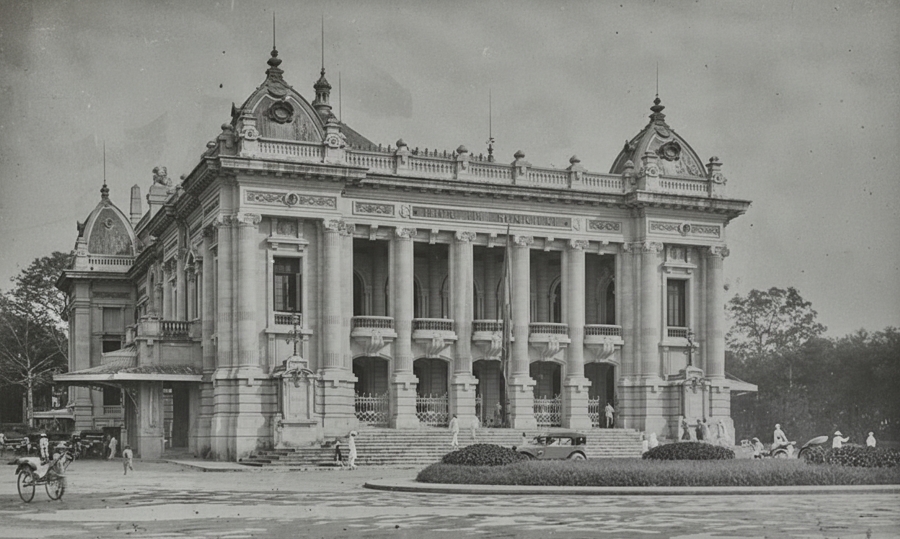
Though the Opera House is officially the work of a studious trio, Lagisquet remains the conductor, the one who wanted to offer Hanoi a tropical Garnier, scaled down to colonial size but inflated with ambition.
Except that the ground, marshy and stubborn, required 35,000 bamboo piles to stay upright.
A financial sinkhole that blew through budgets, deadlines, and public patience. Furious taxpayers saw it as a “luxury toy” for white-gloved elites, built in sublim disregard for the city’s actual needs. And yet, once completed, the building deploys its Ionic columns, its balustrades, and its dome like an aristocrat in the tropics. Inside, Carrara marble and gilding flex their Beaux-Arts muscles in a way that even the Portuguese might have hesitated to claim.
The Opera House, this “temple” of Neoclassicism designed to exclude and impress, would, in a spectacular twist of fate, become the theater for the end of the colonial era in August 1945.
Charles Delpech : a bit of sobriety in this brutal world
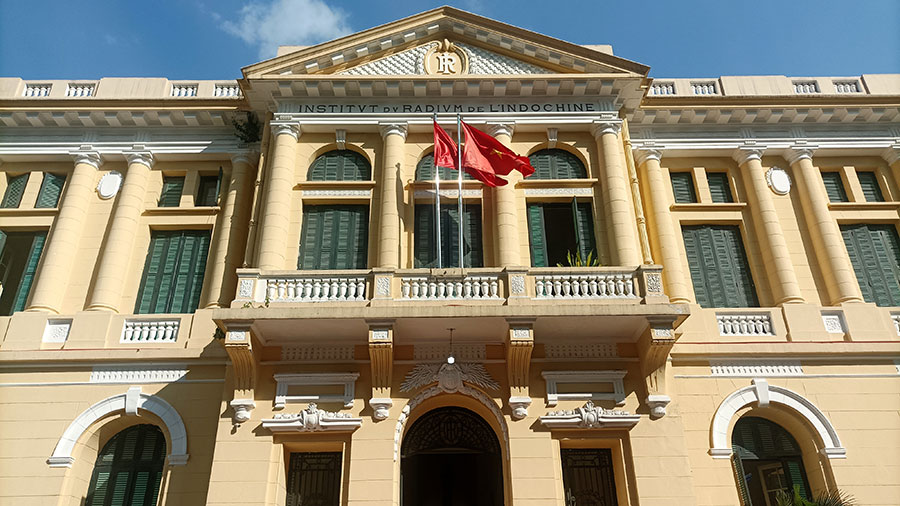
The Radium Institute of Indochina, founded in 1923 on Quan Su Street, is one of my favorite buildings.
Perhaps because I discovered it recently and quite by chance, but mostly because one can still slip inside, unlike so many colonial behemoths barricaded behind their own importance. Charles Delpech practices a Neoclassicism in a white lab coat: wise symmetry, straight lines, columns put on a diet—nothing that seeks to shine for the gallery. Here, there is no marble to impress, just an architecture that steps back in the face of science and care, almost monastic in its austerity.
Marie Curie herself supported the creation of this institute. She personally sent the first tubes of radium to Hanoi to enable brachytherapy treatments.
The arrogance of “Hanoi yellow”
Even the color, that ochre yellow so famous today, was a hostile takeover. In France, yellow evoked the stone of Caen or Paris. In Hanoi, it was the color of the Emperor of Annam. By painting all its administrative buildings yellow, France seized the local imperial symbol, signifying that the new “Son of Heaven” was henceforth the Governor-General.
The awakening
Starting in the 1920s, in direct reaction to the failures of strict Neoclassicism, the administration and architects realized that one cannot sustainably govern a country while ignoring its climate and culture.
This is where the Indochinese style appears, a true architecture of compromise, spearheaded by Ernest Hébrard. That is the other story I am going to tell you.