Taliouine – Fint Oasis – Ouzoud Falls – Ifrane
I leave the gorges of Aït Mansour with real reluctance — and dear Abdou along with them — and set off onto a road twisting through arid valleys and plateaus dotted with tiny Berber villages whose earthen houses dissolve into the mountainside. The landscape is fiercely mineral, often gripped by an immense solitude. Folded desert mountains announce the approach to Taliouine, known as Morocco’s saffron capital.
That evening, my host Souad invites me to the iftar meal before leading me across the street to meet the local youth. Under the wing of a community association, they fizz with ideas and sociocultural projects. Brief as my stay was, it was enough to make tangible the vitality and creative ferment of this Moroccan youth, now fully opened up to the world by the digital age.
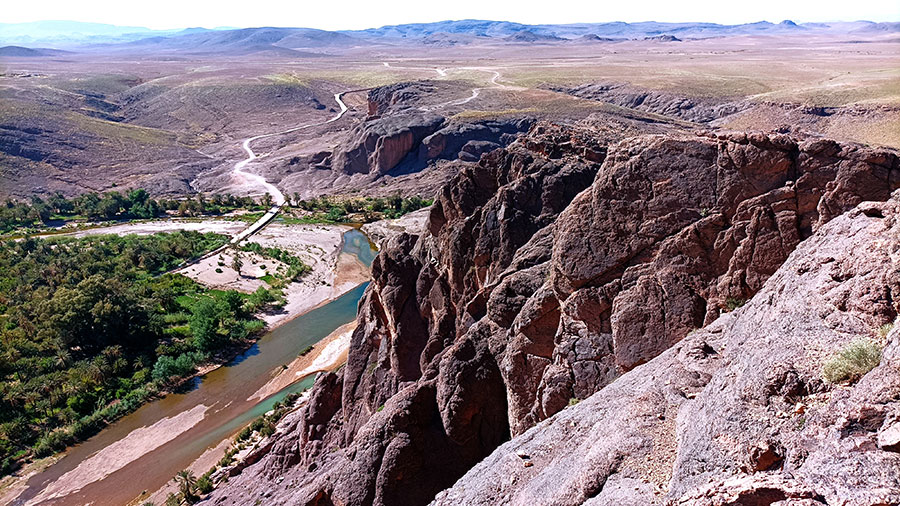
I hit the road again the next morning with one goal in mind: a swim in the Fint Oasis, which suddenly erupts after three hours of aridity. After the dry heat of the road, the shade of date palms and oleanders, and the babbling of the oued, feel like the ultimate reward.
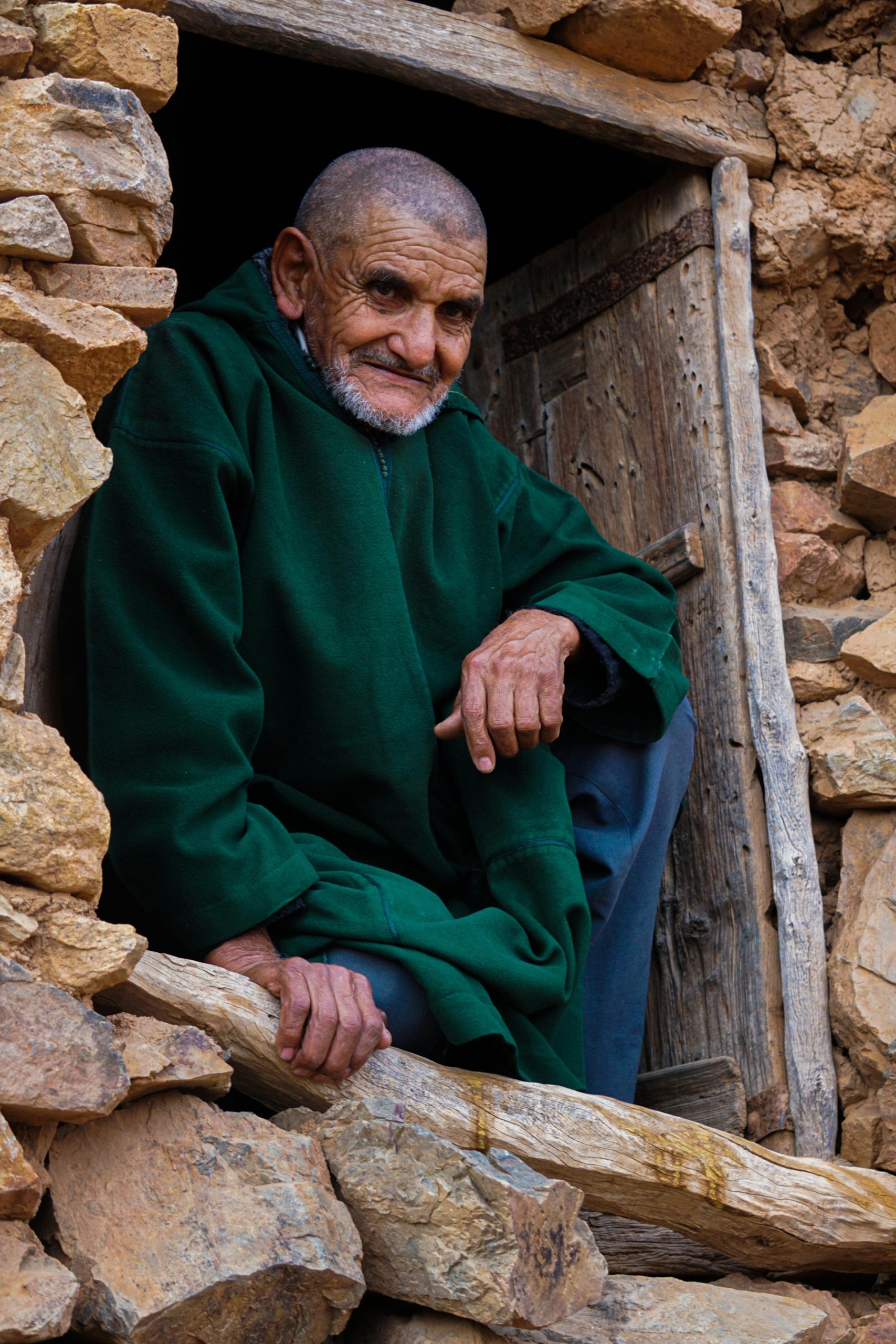
That evening, at the Auberge des Roches Noires, Rachid’s mother treated us to a magnificent couscous. Rachid — the young owner, raised in France before deciding to settle back on his parents’ land — moved through the room with the easy confidence of an oasis prince in his traditional Berber attire. Isabelle, seated next to me, could not stop praising him, gazing at him with full-on gazelle eyes.
Then came the tea, and with it, the music. Rachid and his companions drew their instruments the way other men draw swords. The first chords were enough for Isabelle, suddenly possessed by the spirit of the desert, to begin clapping along with considerable enthusiasm. Her fitted djellaba swayed to the rhythm, while her plunging neckline joined the performance with such fervour that it visibly energized the musicians. Delighted by this unintended metronome, they played with even greater gusto.
Her husband, meanwhile, sipped his tea with the calm resignation of a man who understands that Moroccan civilization rests upon three pillars: hospitality, music… and patience.
But eventually, he noticed that his wife’s orchestral contribution was gaining a little too much amplitude. So, with a discreet yet imperial gesture, he brought the festivities to an end, took his better half by the arm, and evacuated the premises. A brief silence hovered above the carpets before the whole room burst into laughter, and the music resumed with twice the energy.
Not having seen Isabelle at breakfast the next morning, I left without saying goodbye — or congratulating her on her sense of rhythm. I headed north convinced that no one buys a djellaba that tight and low-cut in Morocco by accident.
And it was while driving the magnificent winding roads of the High Atlas that another certainty struck me: Isabelle had planned her move all along.
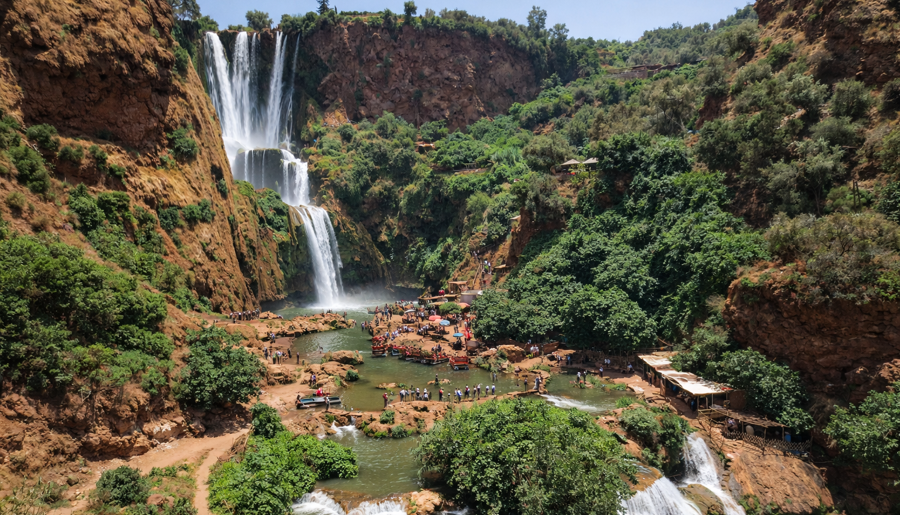
Yes, the Ouzoud Falls are spectacular — provided you get there around eight in the morning. Seeing the restaurants and souvenir shops only just beginning to stir awake at that hour, I could already picture the carnival awaiting by ten or eleven, once the buses from Marrakech started disgorging their nauseating tides of tourists.
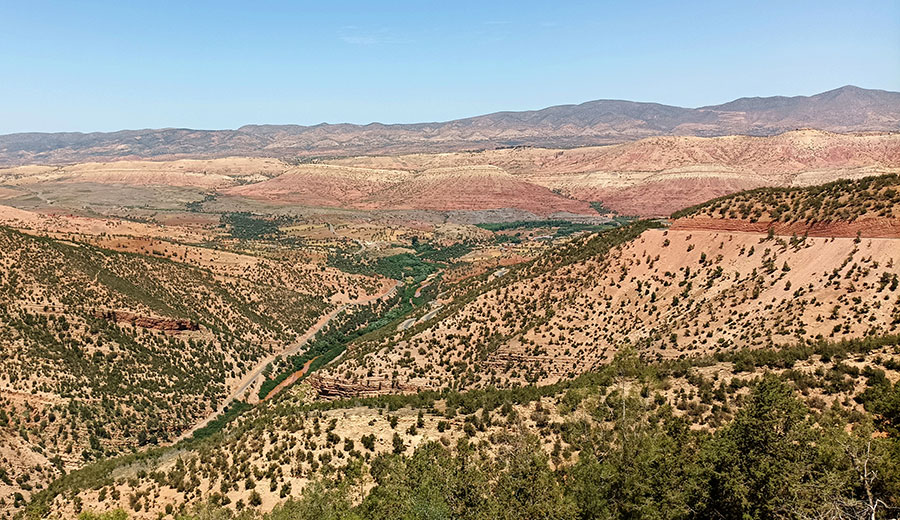
Beyond Ouzoud, the road pushes into dry, rocky valleys. At times, it skirts the steep canyons carved by the Oued El Abid, before a succession of mountain passes unveils staggering horizons of rolling hills streaked in yellow, green, ochre and rust, all standing sharply against an intensely azure sky.
Then, after one final series of winding bends, the landscape delivers its last surprise. Amid the barren ochre ridges of the Atlas appears an immense turquoise-and-emerald expanse: Bin El Ouidane Lake. An inland fjord. A sheet of deep blue artificial water cutting brutally through the arid land surrounding it. The road coils high above the lake, serving up dizzying panoramas at every turn.
The farther north I drive, the greener and denser the landscape becomes. The air thickens with the smell of undergrowth and resin. First comes the realm of the holm oak, then majestically, that of the cedar. The road turns into a corridor through vast forests, among them the famous Gouraud cedar forests.
And then, suddenly, the scenery shifts once more: arrival in Ifrane. The alpine illusion is complete. With its sloping roofs, chalet-style architecture and strangely orderly atmosphere, the town feels less like Morocco than some misplaced mountain resort — the so-called “Switzerland of Morocco.”
Fez – Chefchaouen – Tetouan – Tangier
I leave behind the final folds of the Middle Atlas — and with them a certain quiet sovereignty — before plunging into the turbulence of a great city. Nervous traffic, tourist frenzy, everything here vibrates louder.
For all my love of mountain solitude and the intimate shelter of tiny family-run inns, I simply cannot snub Fez. What a shock of contrast. After days spent driving through near-ghost villages hollowed out by Ramadan, the medina of Fez hits me like a tidal wave.
It is a baroque opera performed in narrow alleyways: people sing, shout, bargain, argue — the whole place breathes history with overflowing lungs. At prayer time and during iftar, it briefly holds its breath. Then the spectacle surges back to life with the flamboyant elegance of a bazaar fully aware of its own powers of seduction.
It is also the perfect excuse to stray from the endless procession of tagines and couscous — excellent though they may be — served generously in roadside auberges, and instead dive headfirst into Moroccan street food. And the Fez souk does not hold back. Skewers hiss over charcoal, pastilla flakes onto your fingers, chickpea fritters pile up beside buttery msemen served with gloriously rogue charm.
Ah yes — the traveller’s little golden tragedy: dreaming of a cold foaming beer overlooking the souk… only to discover that Fez, ancient and modest, has no intention of indulging such sparkling fantasies.
The kif will have to wait for the Rif.
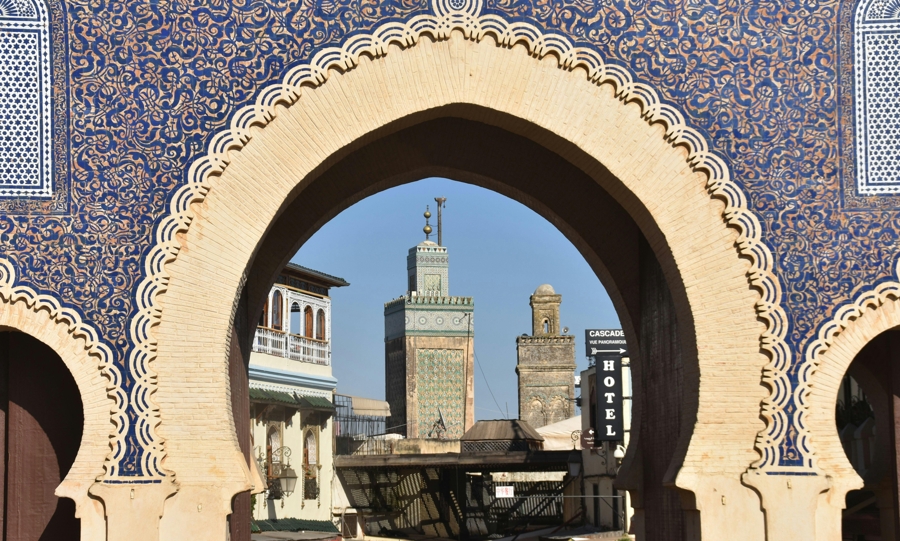
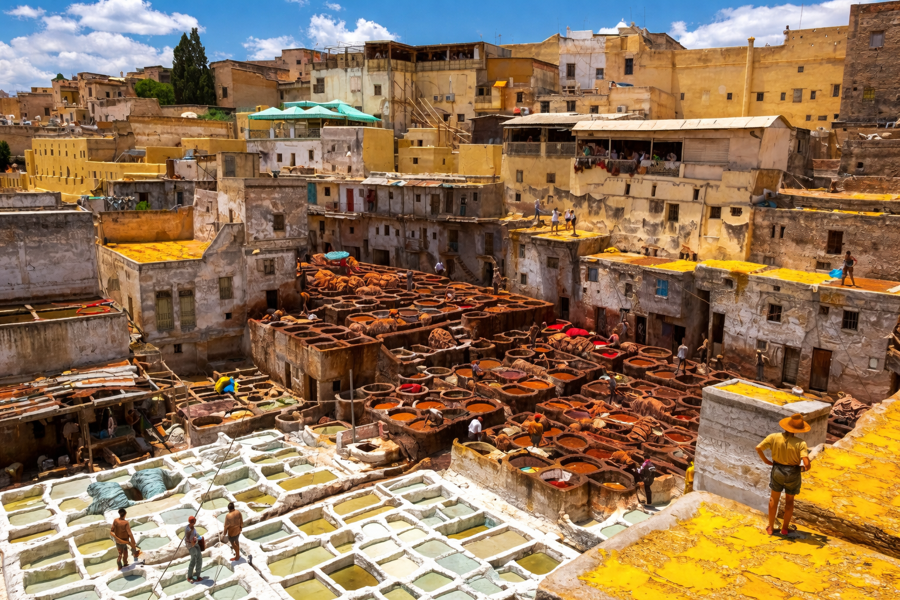
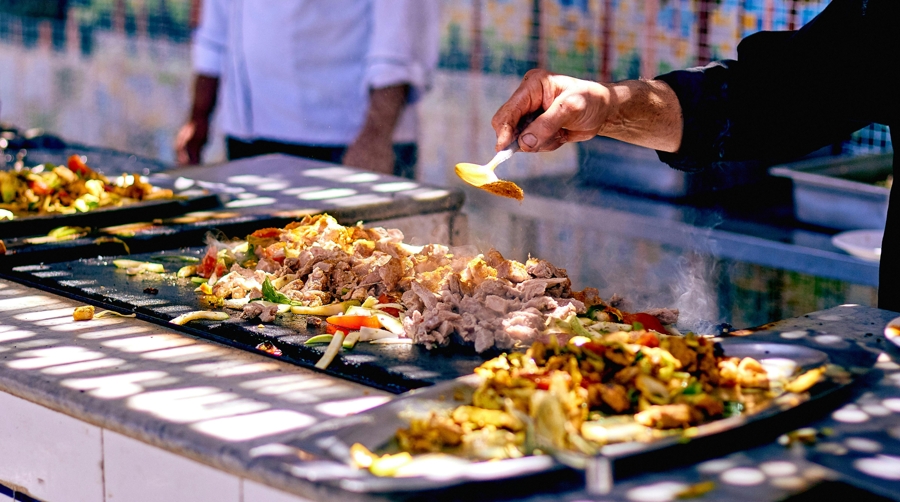
I leave behind the souk and the weight of dynasties, continuing north toward the foothills of the Rif. The land turns greener here, less scorched than the Atlas. The sky closes in. With every bend in the road and every mile deeper into the mountains, the landscapes take on a kind of austerity. The green darkens. The ridges grow sharper, more jagged, more severe.
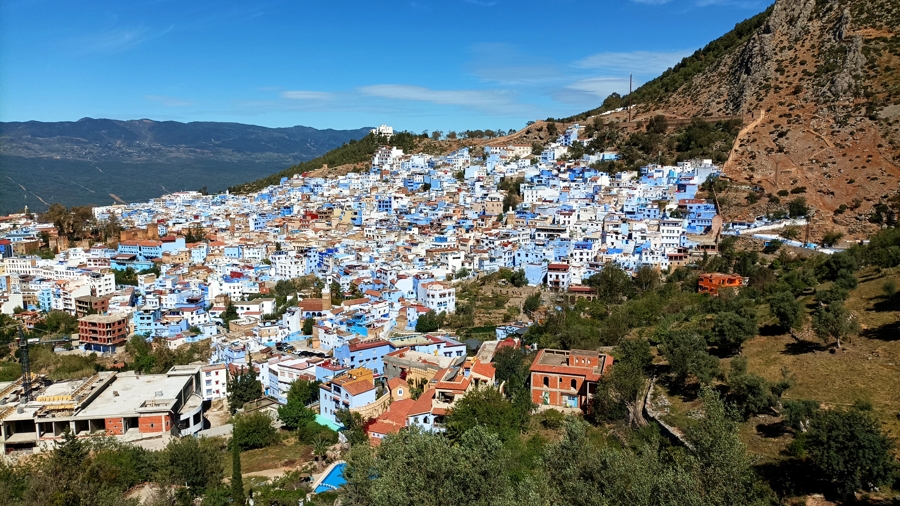
And then suddenly, Chefchaouen appears in the distance.
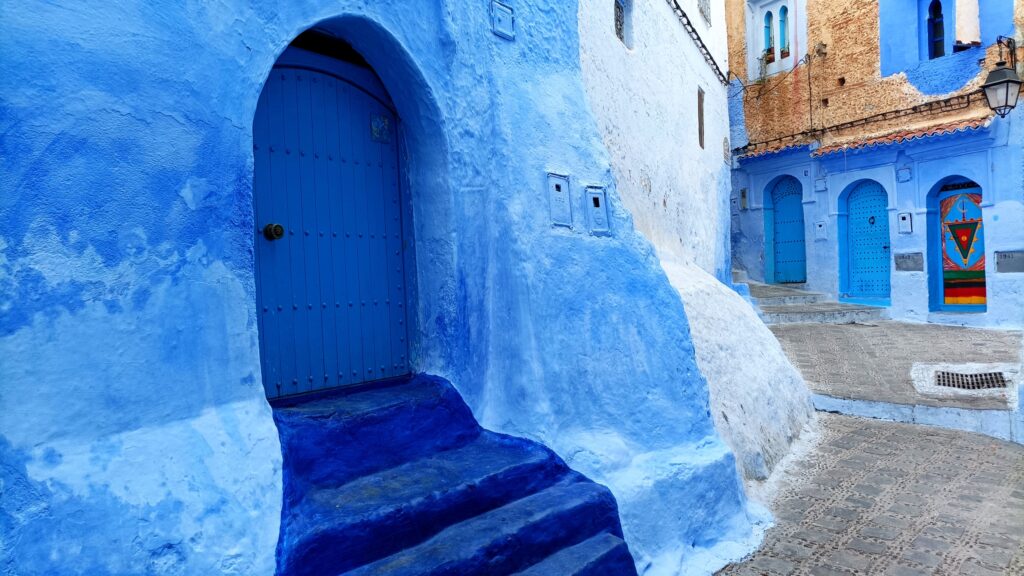
The arrival is an aesthetic shock — a rupture. You do not discover Chefchaouen; you receive it. Like a dream painted in indigo blue.
To wander through the medina of Chefchaouen is to enter a sensual meditation on color. It is to walk through a labyrinth where every alley feels like a trompe-l’œil painting, the bluewashed walls trapping and bending the light in hypnotic ways.
But beauty, when too perfect, risks becoming tyrannical. Repetition dulls even wonder. That is Chefchaouen’s trap: the monotony of enchantment.
So the next day, I escape into Talassemtane National Park to clear my eyes a little. It is a return to the Rif in its raw state, where beauty is no longer painted onto walls but hacked straight out of the mountainside with a cleaver.
And then comes one of the great moments of the journey: the end of Ramadan.
One morning, from the terrace of a café, I watch Chefchaouen launch itself into a ballet of visits and greetings. People emerge dressed in their finest clothes, moving from house to house exchanging the ritual words of Eid Mubarak. The generous kisses on the cheeks become a sacred gesture of reconciliation and renewal. I exchange a few of them myself with my neighbours at the next table before getting back on the road toward the Mediterranean coast.
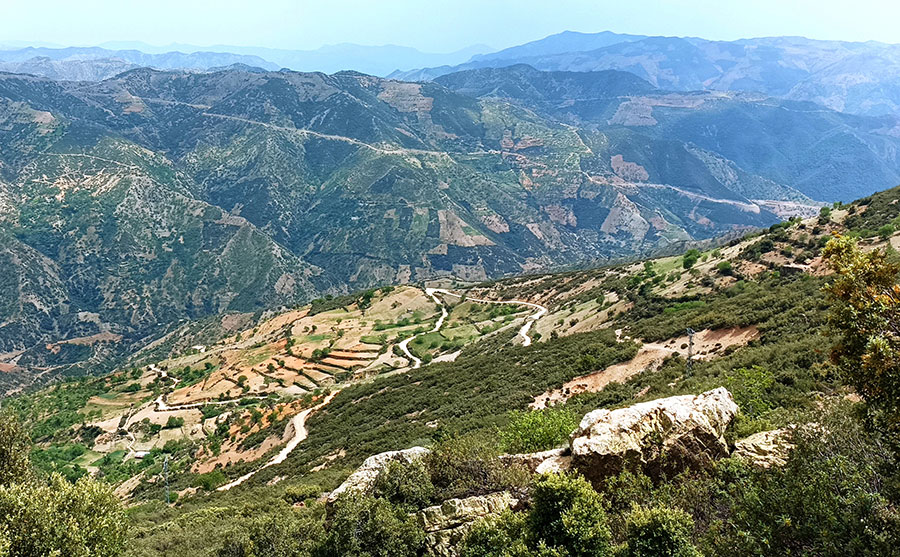

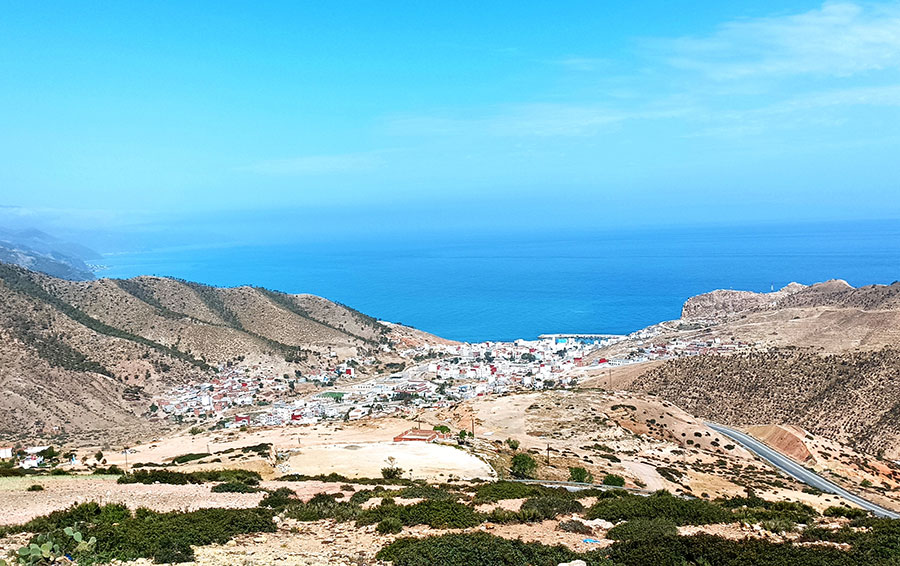
In the heart of the Rif Mountains, the road strings together mountain passes, valleys populated by farmers riding donkeys, and small traditional villages clinging to the slopes. Once past the highest elevations, the descent toward the coast begins gradually. The scents of cedar and cork oak give way to drier, saltier air.
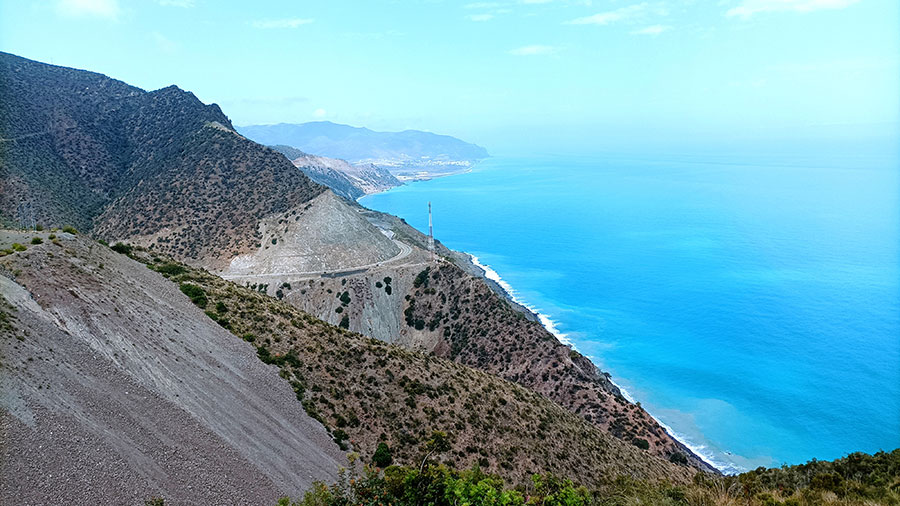
Soon the coastline appears — rugged, mineral, as though the mountains themselves were leaning down to drink from the sea.
Torres de Alcalá. Cala Iris. Names that instantly project me onto the rocky shores of Mallorca or Menorca.
A little too quickly, perhaps, because I promptly collapse face-first onto the bed at the auberge. Outside, the sky pulls faces, spits drizzle, puts on a performance. Ah, the Mediterranean… what a diva she becomes when she’s in one of her moods.
The next morning, she decides to behave beautifully. And so do I, to be fair.
For this final stretch, I can already tell the day will unfold flawlessly, Morocco preparing one last grand gesture — an ultimate bow — by unrolling the coast all the way to Tetouan. A country which, truly, has never hesitated to overdo things a little when trying to dazzle its audience.
And I have to admit: it works.
The coastal road between Cala Iris and Tetouan walks a tightrope — a ribbon of asphalt winding above a Mediterranean of insolent blue, trapped between sheer cliffs and russet hills plunging toward the water. In some places, the sea seems to bite into the rock itself. Elsewhere, it stretches lazily beside pale little coves where a few fishing boats merely pretend to work.
The wind meddles in everything — at times a caress, at times a slap — giving the landscape the feel of an unfinished chronicle. You drive, you drift, you let yourself be pulled along: the Rif softens, the light turns chalky, and already Tetouan begins to appear in the distance — white, immaculate, dressed as though determined to make a good first impression.
I’m completely won over. Totally.
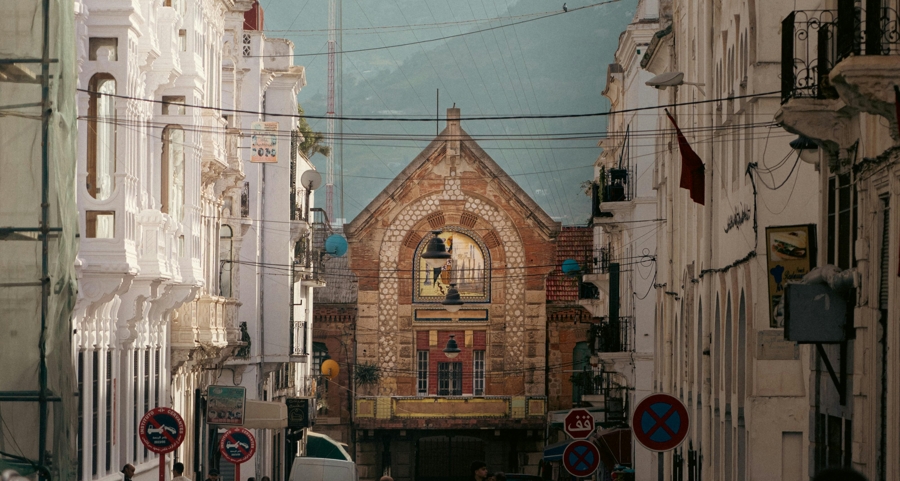
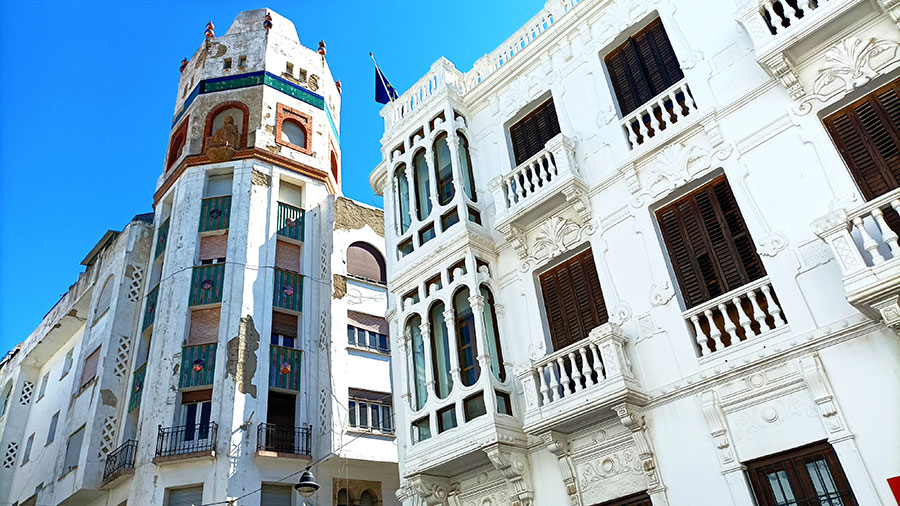
Broad avenues drawn with ruler-straight precision, Moorish architecture flirting shamelessly with Art Deco and the Belle Époque, dazzling white walls, terraces stretching out as though the city itself wanted to keep me a little longer.
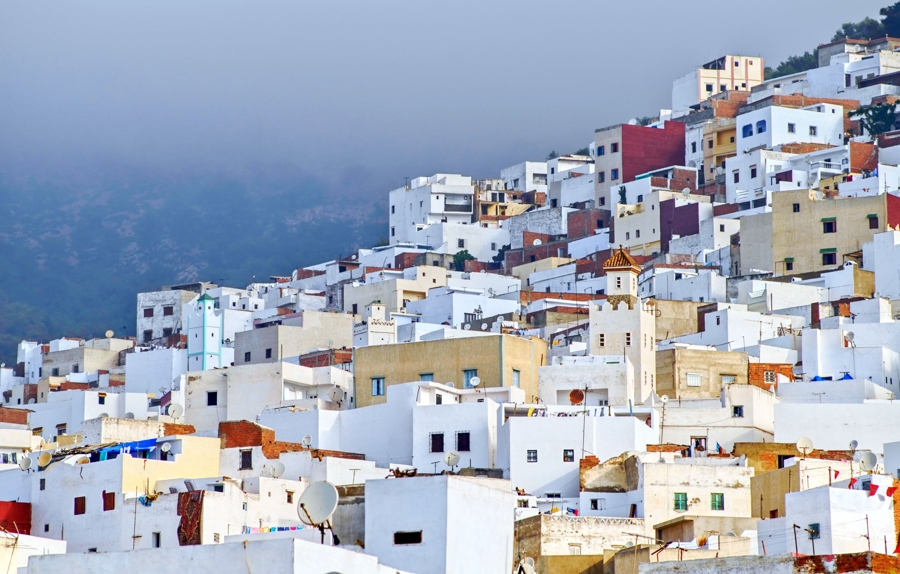
From the rooftop terrace of El Reducto, the medina struts below me. I feel like Matisse on a bender: blue, white, flashes of red snapping from laundry lines in the wind.
I sip a beer, then two, then three, replaying the film of the past few days: battered roads, stubborn mountain passes, mud-brick villages, silhouettes encountered by chance, muezzin calls hanging motionless above the mountains.
Tetouan works its charm, and honestly, I let it happen. A little too willingly, of course.
Soon enough I find myself swallowed by the medina’s inextricable labyrinth — so obedient from above, so ravenous once you step inside it, especially when you happen to be staggering slightly.
I do eventually uncover my hotel, which also happens to double as a café. Someone offers me a chair, a little of that legendary Rif kif pipe… and I collapse onto the bed like a fallen prince, while Isabelle starts clapping her hands again.
Or maybe that was just my temples pounding.
The next morning, I return to my rooftop terrace — not to drink this time, but to treat my hangover with couscous. And what a couscous it is. Possibly the best of the entire trip. Though not as good as my mother’s, obviously. Let’s not get carried away.
I drift through Tetouan for the rest of the day, waiting for tonight’s departure, fully aware that the road to Tangier has nothing poetic about it: a dreary succession of soulless seaside resorts, followed by landscapes growing harsher, more urban, more industrial, the closer one gets to the port.
And it is there, on the docks — not the romantic platform of some station, but the real thing, smelling of salt and diesel — that I say goodbye to Morocco.
Like a summer love affair to whom you promise, with slightly too much confidence, that you’ll write, and that you’ll see each other again very soon.
Inch’Allah.